
Zucchini Pollination – Pop Quiz
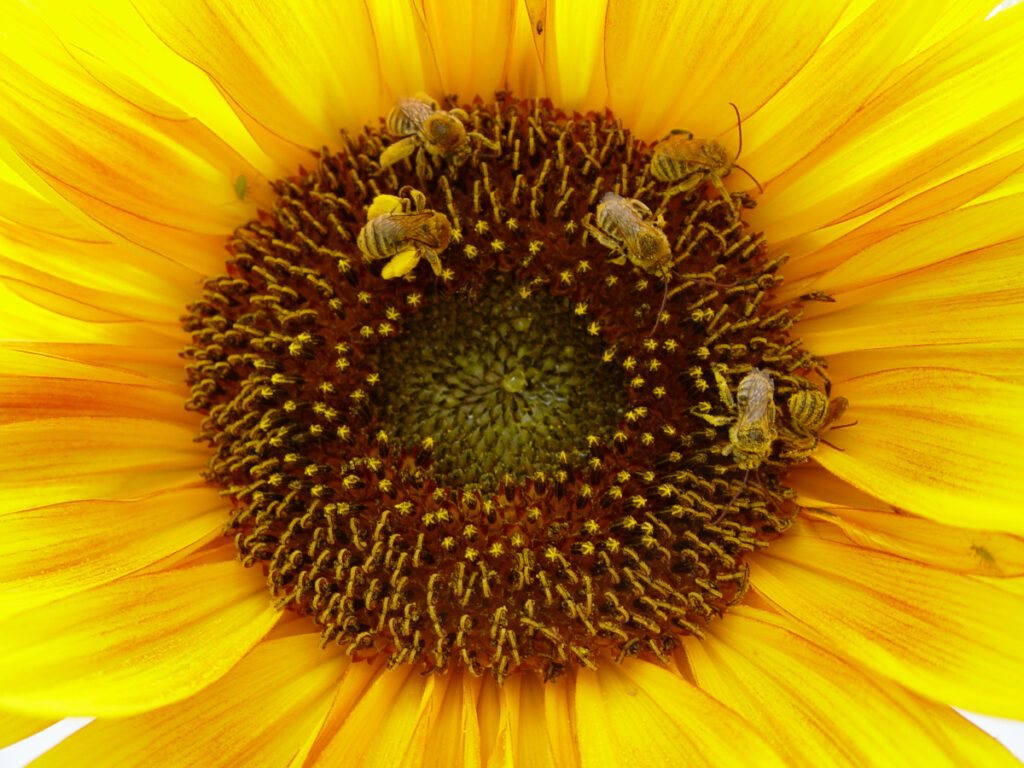
The following are squash flowers from a zucchini plant. One is male, the other is female. Can you identify which is which? I’ll give you a hint…when the male pollen fertilizes the female ovary zucchini seeds are created and the ovary swells to carry the seed.
Here’s a thought, wouldn’t it be great if “the birds and the bees” were taught where the birds and the bees actually congregate? What do you think?
AVID Gardeners at Mark Twain Middle School Create Masterpiece
Jane Andino, Teacher/Volunteer and UCLA Education Graduate Student had an idea. She envisioned an educational curriculum that would involve students acting as catalysts for a widespread movement: one in which each school and community would create and nurture a communal garden.
Her idea was realized at Mark Twain Middle School in Venice, CA with considerable help from a talented group of volunteers, a dedicated teacher, Jill Usui, and the hard work and creativity of a special group of 7th and 8th grade students in the Advancement Via Individual Determination (AVID) class.
Over the course of this past school year, the students researched the history and daily maintenance of their well-known school garden and then created a resource packet, a brochure and the above video to inspire other communities to build and maintain their own school garden. For more information about The Process and The Schedule of this unique pilot program please visit Jane’s website at creatingschoolgardens.wordpress.com.
One lesson they learned immediately is that the creation of a school garden cannot be done alone. Many hands are needed. Fortunately for Jane and her students, Mark Twain Middle School already had some very formidable volunteers in the way of Master Gardeners and Community Volunteers who call themselves the Gardenistas.

From L to R: Master Gardener Idalia Ramirez, Community Volunteer Michael Stenger, Master Gardener Marianne Brown, Master Gardener Patty Kestin, and Master Gardener Renee Meshul.
The Gardenistas were responsible for not only assisting Jane and her students in their project but also crafting the Mark Twain MS School Garden into the jewel it is today.
Well done Mark Twain Middle School, your namesake would be proud!
How To Transplant a Tomato Seedling
Tomatoes plants are almost always transplanted into our garden from seedlings. Whether you grow the seedlings yourself or buy them from a nursery it is best to remove the lower branches and bury the stem up to the uppermost leaves.
The reason we do this is because the hairs along the lower stem will develop into roots. They will enable the tomato plant to take in more water and nutrition from the soil.
Seed Saving in a School Garden
It is late winter and many of the crops from our September planting are either finished (cauliflower, broccoli, peas, beets, and carrots) or bolting (cilantro, lettuce, arugula). Now is the time to pick out which plants we want to save for seed. Choose plants that are healthy, vigorous and with characteristics worth saving. The red Lollo Rosso lettuce below is being chosen for its deep red leaves. We have placed a stake next to with a large circled “S” on it. This is to remind us that we are saving this plant for seed and not to harvest it.
Our arugula was fantastic this year, the lobed leaves were very mild compared to the more bitter arrow-like leaves even late into the season so we are letting the entire patch go to seed.
“Maintaining the genetic diversity within a population is the key to its continued evolution and the ability of the plants to adapt to varying environmental conditions. To avoid detrimentally decreasing the genetic diversity being maintained within a population of plants, seeds should be saved from the greatest possible number of plants that meet the selection criteria.” – Suzanne Ashworth, “Seed to Seed”
Mushrooms in your Vegetable School Garden
During mild, wet, winter months it is not uncommon to see mushrooms growing among your vegetables. With mushrooms invariably come questions: what is it and what do we do about it.
First, DO NOT EAT THEM, mushrooms may be lethally poisonous, especially with young children and older adults.
A recent case of mushroom poisoning occurred in California when a care-giver at a nursing home picked some poisonous mushrooms and served them in a gravy. Four individuals died.
Mushrooms are a fungus and classified in the kingdom of Fungi, which is different from the other kingdoms such as Animalia, Bacteria and Plantae.
They show up in plant beds often when there is woody mulch present.
In nature, Fungi are part of the great recycling that occurs in forests and other woody areas. When trees and plants die in the forest, mushrooms assist in their decompositon.
To rid your beds of mushrooms do not just remove the mushroom but also the surrounding soil. This way they will have less chance of growing back.
You may dispose of poisonous mushrooms in your compost pile. They are actually very helpful in breaking down organic matter.
For more info see, Mushrooms in the Garden Beds from the Texas A&M Agrilife Extension.